 Share on Twitter
 Share on Facebook
 Share on LinkedIn
Machine vision systems are entering a new era. Sensor resolutions continue to climb, frame rates keep increasing, and AI workloads demand ever more compute resources. While traditional GigE Vision architectures have served the industry well, many developers are discovering that moving larger volumes of image data through conventional Ethernet transport creates new challenges around CPU utilization, integration complexity, scalability, and system performance.
GEV-Stream™ was developed to address these challenges.
Rather than providing a standalone FPGA IP core or a collection of disconnected components, GEV-Stream delivers a complete transmit-to-receive GigE Vision 3.0 imaging transport platform. By combining the imavix engineering GigE Vision 3.0 FPGA IP Core with Pleora’s proven eBUS SDK and receive-side ecosystem, GEV-Stream gives camera manufacturers, embedded vision developers, and imaging OEMs an end-to-end path to next-generation Ethernet imaging.
Why Traditional Architectures Are Reaching Their Limits
The machine vision industry is experiencing rapid growth in image sizes, bandwidth requirements, and AI-driven processing demands. As organizations move beyond 10GbE imaging architectures, traditional UDP-based streaming approaches can consume valuable CPU resources, create receive-side bottlenecks, and make it difficult to scale systems to higher bandwidths.
At the same time, OEMs face pressure to accelerate development schedules while managing engineering costs and reducing risk. Building and maintaining a custom transport architecture often requires significant investments in FPGA development, networking expertise, host-side software, validation, and long-term support.
The result is a growing need for a transport platform that can support higher-performance imaging systems without increasing development complexity.
A Complete Imaging Transport Platform
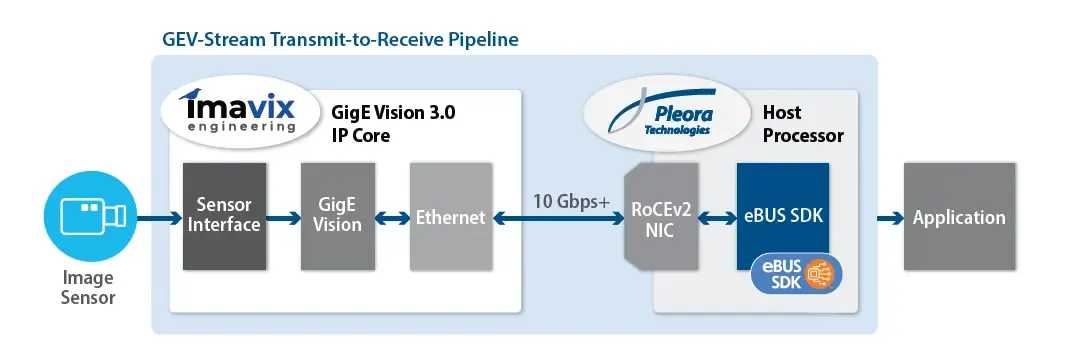
GEV-Stream is designed as a complete imaging transport solution that spans the entire imaging pipeline, from image sensor to application. The platform integrates the transmit layer, transport layer, receive infrastructure, development framework, and engineering support into a unified architecture.
At its core, GEV-Stream combines:
- GigE Vision 3.0 FPGA IP Core
- RoCEv2 / RDMA transport
- GenDC support
- Pleora eBUS SDK receive framework
- Host-side drivers and receive optimization
- Device discovery and control capabilities
- Development tools, examples, and engineering support
This integrated approach reduces the need for customers to assemble, validate, and maintain multiple vendors’ technologies while preserving familiar GigE Vision development workflows.
Unlocking the Benefits of GigE Vision 3.0
One of the most significant advantages of GEV-Stream is its adoption of GigE Vision 3.0 technologies, including RoCEv2 and RDMA-based transport. These technologies help reduce CPU involvement in image transfer operations while providing efficient movement of image data across Ethernet networks.
For developers building AI-enabled vision systems, this means more processing resources remain available for inference, analytics, image processing, and application logic. Instead of consuming compute resources managing image transport, systems can focus on extracting value from the data itself.
The platform also supports GenDC, enabling advanced imaging data structures and preparing developers for future payload complexity as imaging systems continue to evolve.
Faster Development with Lower Risk
Many organizations underestimate the effort required to build a complete Ethernet imaging infrastructure. High-bandwidth imaging systems involve cameras, FPGA designs, NICs, operating systems, device control, stream negotiation, buffering, and host applications. While these individual elements may function correctly in isolation, integration challenges often emerge when the complete system is assembled.
GEV-Stream helps reduce these challenges by delivering a validated architecture that includes both the transmit and receive sides of the imaging pipeline. Developers gain access to the eBUS SDK, development tools, examples, device discovery mechanisms, and optimized host-side components, reducing integration and validation effort.
The result is faster proof-of-concept development, accelerated time-to-market, and lower project risk.
Built for Scalability
Many imaging platforms being designed today will need to support significantly higher bandwidths tomorrow. Organizations are already planning migration paths beyond traditional 10GbE systems as sensor technology and AI applications continue to advance.
GEV-Stream was designed with this reality in mind. The platform provides a roadmap from today’s 10GbE and 25GbE systems toward future 40G, 50G, and 100G+ imaging architectures. By adopting a standards-based approach, developers can build systems that evolve alongside future network and imaging technologies.
This scalability helps protect engineering investments while providing flexibility for future product generations.
Focus on Imaging Innovation, Not Transport Infrastructure
Ultimately, GEV-Stream is about helping imaging developers spend less time solving transport challenges and more time delivering customer value. The platform removes much of the complexity associated with high-performance Ethernet image transport while preserving the interoperability benefits of the GigE Vision ecosystem.
For camera manufacturers, embedded vision developers, and OEMs building the next generation of AI-enabled imaging systems, GEV-Stream offers a practical path forward: lower CPU utilization, faster development, reduced lifecycle costs, and a scalable architecture that is ready for tomorrow’s bandwidth demands.
GEV-Stream is not simply an IP core. It is a complete GigE Vision 3.0 imaging transport platform designed to help organizations build faster, smarter, and more scalable imaging systems.