Share on Twitter
 Share on Facebook
 Share on LinkedIn
EO/IR cameras, thermal imagers, LiDAR, and other sensing technologies are giving operators access to increasingly rich information about their surroundings.
As sensing capabilities expand, defense organizations face a growing challenge: moving increasingly large volumes of data from sensors to processing systems and displays quickly, reliably, and in a form that operators can use. At the same time, platforms need to accommodate equipment from multiple suppliers, integrate new processing technologies, while continuing to supporting legacy systems that may remain operational for years.
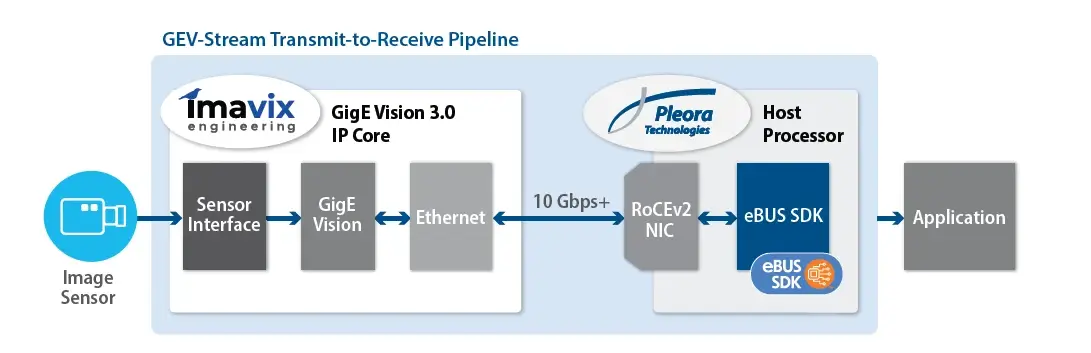
The result is a growing need for a flexible data backbone that can connect sensors to decisions without adding unnecessary integration complexity. This challenge can be addressed with standards-based, low-latency connectivity designed to move information reliably from the source through to processing and ultimately to the operator.
The Challenge Is Moving Data, Not Just Collecting It
Today’s military platforms can include numerous imaging and sensing devices operating simultaneously. More sensors can improve visibility, detection, and intelligence, but they can also create significant demands on the systems processing their data.
High-bandwidth streams need to move reliably and with predictable latency. Processing resources must turn raw sensor information into useful intelligence. Displays and applications must receive relevant information quickly enough to support operational decisions.
This makes connectivity an increasingly important part of the system architecture.
Dual-use interconnect technologies can provide data transport, synchronization, and interoperability, connecting sensors, processing systems, applications, and displays. Deterministic, low-latency transport helps to ensure that critical sensor information arrives where it is needed, when it is needed.
Bringing Intelligence Closer to the Sensor
The challenge becomes even more significant when communications are constrained.
Bandwidth limitations, network congestion, and contested communications can make continually transporting large amounts of raw sensor data difficult. One approach is to move more processing closer to the edge.
By enabling sensor data to be processed at the edge, systems can analyze important information locally and transmit only the data required by higher-level systems. This can reduce latency and dependence on constrained communications links while helping operators maintain situational awareness.
For autonomous platforms and UAVs, this approach can also help connect sensors directly with embedded processing while minimizing size, weight, and power requirements.
From Individual Streams to a Coherent Picture
Getting information from one sensor to one application is only part of the challenge.
Modern platforms often need to combine data from video, EO/IR, LiDAR, thermal imaging, and other sources. These inputs may be produced by different devices, at different rates, and potentially by different suppliers.
Multisensor integration can be simplified by packaging heterogeneous sensor streams into synchronized, time-aligned data sets for processing and visualization. The goal is to reduce the effort required to combine different data sources while improving end user confidence and critical decision making.
Interoperability Becomes a Mission Requirement
Defense platforms rarely remain static throughout their operating lives. Sensors are replaced. Processing capabilities increase. New AI-based applications are introduced. Different suppliers contribute equipment at different stages of a program.
Without an interoperable architecture, every upgrade is at risk of becoming another custom integration requirement.
Standards-based connectivity provides a different path. This approach connects sensors, processors, and displays from multiple suppliers within a common architecture, helping to reduce integration complexity and allow systems to evolve as requirements change. Future proofed flexibility is particularly important as defense organizations shift toward more modular and upgradeable systems.
A Foundation for the Next Generation of Defense Platforms
Whether the application is vehicle situational awareness, persistent surveillance, ISR, autonomous systems, multisensor fusion, or threat detection and tracking, the underlying requirement is similar: sensor information needs to reach processing and decision systems reliably and with minimal delay.
As defense platforms add more sensing and intelligence, connectivity becomes more than an interface between components. It becomes part of the architecture that determines how effectively information can be used.
The opportunity is not simply to deploy more sensors. It is to create a standards-based data backbone that turns those sensors into a coordinated source of actionable intelligence.
For defense system designers, that means focusing less on moving data between disconnected technologies and more on using that data to improve awareness, accelerate critical decisions, and support mission effectiveness.