Share on Twitter
 Share on Facebook
 Share on LinkedIn
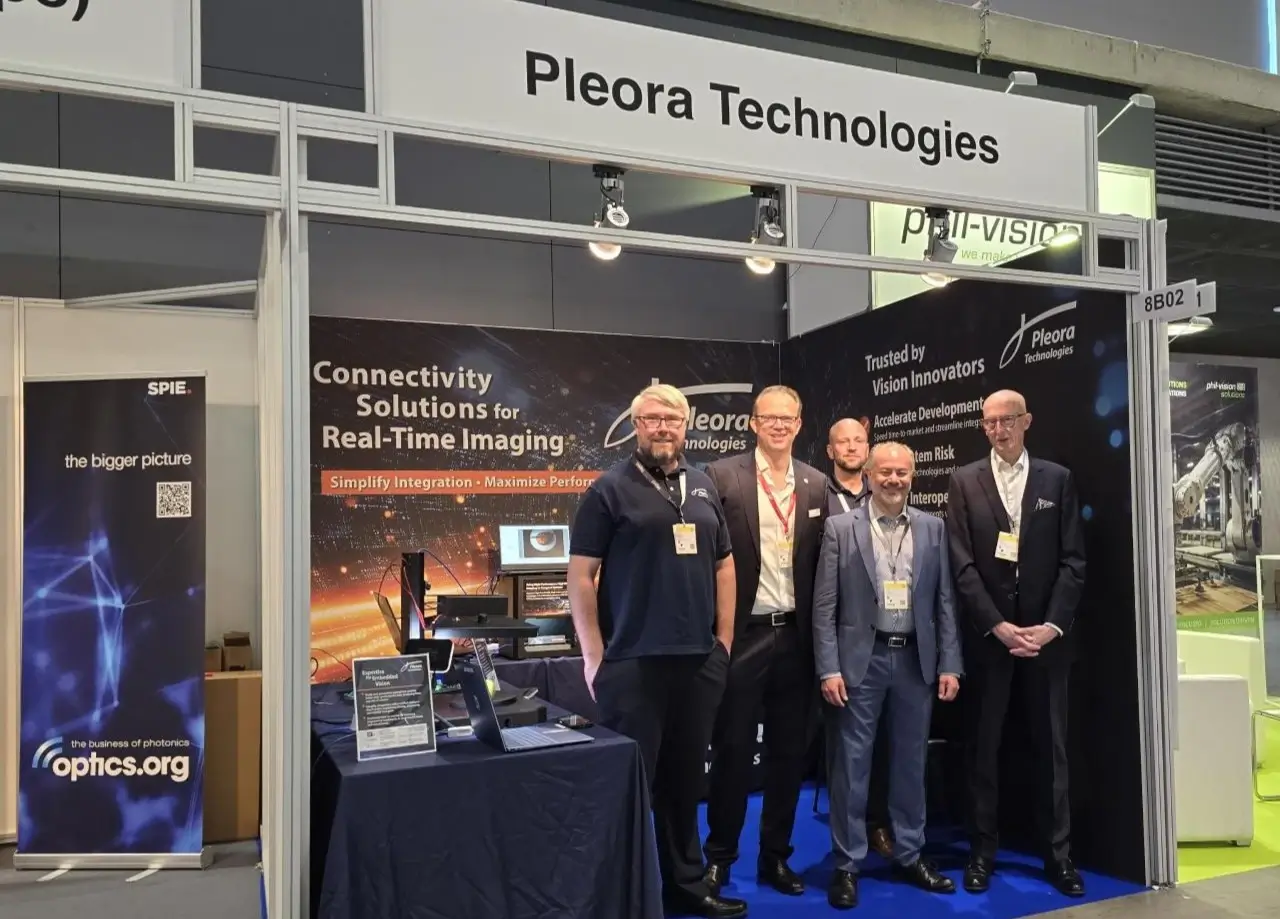
VISION Stuttgart brings together the machine vision industry to showcase new technologies and discuss where the market is heading. This year’s event was particularly active, with more than 500 exhibitors.
For Pleora, the show is an opportunity to meet customers and discuss technologies focused on three key challenges: reducing development complexity, moving more data with lower CPU utilization, and modernizing vision systems without unnecessary redesigns.
Embedded Processing Moves Closer to the Sensor
One of the clearest trends at the 2026 show was the rapid shift toward embedded vision. ARM-based processing and MIPI-connected sensors are gaining substantial traction as designers move processing closer to the edge.
At the same time, interest is growing in multisensor systems that combine cameras with 3D, time-of-flight, LiDAR, and other sensing technologies, creating another challenge – moving increasing amounts of data without consuming key processing resources needed for application tasks.
Moving More Data with Less Processing Overhead
At VISION, Pleora demonstrated technologies designed to address these changing requirements.
The GEV-TB external frame grabber connects a high-bandwidth GigE Vision camera directly to a laptop over Thunderbolt. Built-in DMA moves image data into host memory while reducing CPU utilization, freeing processing resources for higher-value application tasks.
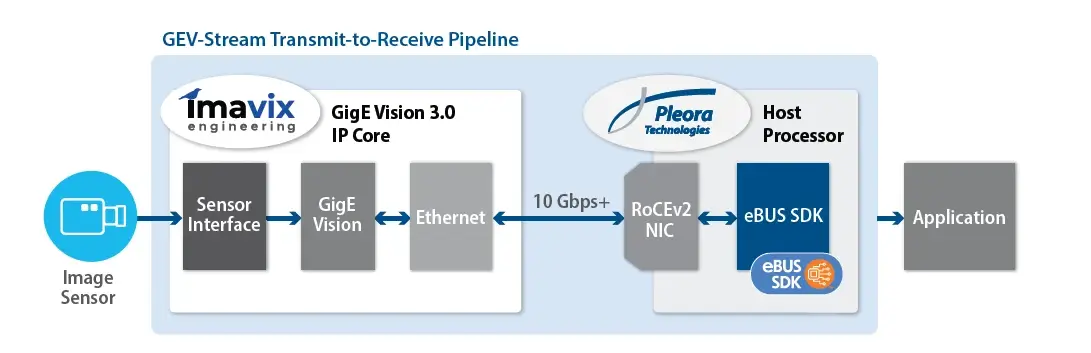
The GEV-Stream GigE Vision 3.0 Transmit and Receive solution combines expertise from Pleora and imavix engineering for advanced imaging systems for end-to-end GigE Vision 3.0 architecture combining FPGA-based transmission, RoCEv2/RDMA transport, and optimized host-side reception. The approach helps reduce CPU utilization and integration effort while providing a path toward higher-bandwidth imaging systems.
Bringing Multisensor Data Together
The Multisensor fusion solution using eBUS Edge and SDK addresses another growing challenge: efficiently combining data from different sensors. It synchronizes 1D, 2D, and 3D sensor data and AI inference, and transports it within a standards-based architecture. Instead of rebuilding the data pipeline when sensors change, the architecture gives developers more flexibility to select and swap sensors while maintaining a common synchronization and transport approach.
VISION Stuttgart reinforced how quickly machine vision is evolving, and how the conversation is shifting towards embedded processing, AI, higher bandwidth, and multisensor systems and an increased need for architectures that move data efficiently while reducing CPU utilization and integration effort.